
Saint Michael's line: the story of a modern legend
- Coordinates
- 48.64° N, 1.51° W
- Stop
- Sacred and mysterious places
- Reading
- 3 min read
- Next
- Mont-Saint-Michel, the abbey amid the tides of Normandy →
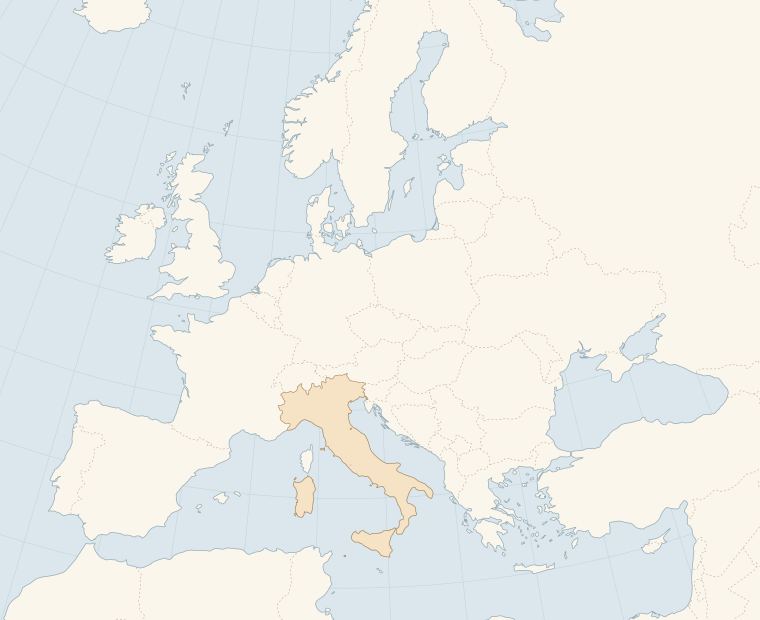
Saint Michael's line supposedly links seven shrines from Ireland to Israel: the origins of the legend, the places involved and what history and geography say.
Among the most widespread legends about Europe's sacred places is that of the so-called Saint Michael's line. According to the tale, seven sanctuaries dedicated to the archangel are arranged along a straight line crossing the continent from Ireland to the Holy Land. The line is said to symbolise the sword stroke with which Michael drove the devil back into the abyss. It is a fascinating story, but it must be presented for what it is: a legend, born and spread mostly in recent times, with no support in medieval sources.
The seven sanctuaries of tradition
In the most common versions the line starts from Skellig Michael, a rocky island off Ireland, touches St Michael's Mount in Cornwall and Mont-Saint-Michel in Normandy, descends into Italy to the Sacra di San Michele in the Susa Valley and the sanctuary of Monte Sant'Angelo on the Gargano, continues towards the monastery of Saint Michael on Symi, in the Dodecanese, and ends at the Stella Maris monastery on Mount Carmel, near Haifa.
Some versions add that the line is oriented towards the sunset on the day of the summer solstice, and that the three main sanctuaries, namely Mont-Saint-Michel, the Sacra and the Gargano, are equidistant from one another. These claims circulate in popular books, travel guides and websites, often repeated without verification and embellished each time with new details. The legend has no recognised author and seems to have taken shape gradually during the twentieth century.
What history and geography say
From a historical point of view, the sanctuaries were founded in very different periods and without any common plan. The Gargano cult dates, according to tradition, to the late fifth century, Mont-Saint-Michel to the early eighth, the Sacra to the late tenth, while the Carmelite monastery in Haifa is a nineteenth-century building. No ancient or medieval document speaks of an intended alignment between these places.
From a geographical point of view, the sanctuaries line up only approximately, on a map and with some tolerance. On a curved surface such as the Earth's, a straight line drawn on a map does not correspond to the shortest route between two points, and with enough places dedicated to the same saint it is easy to find a few near any line at all. Moreover, the distances between the three major sanctuaries are not equal.
Why the archangel loves the heights
There is, however, a real historical element that explains why these sanctuaries resemble one another. From the early Middle Ages Saint Michael was venerated in high, isolated places, often linked to caves or to headlands by the sea. The model was the Gargano, whose fame spread among Lombards, Franks and Irish. The very founding tale of Mont-Saint-Michel says that Bishop Aubert had relics brought from the Gargano for the new sanctuary.
Saint Michael's line is thus a modern tale built on an ancient reality: the network of Michaelic sanctuaries that pilgrims truly connected, with their journeys, for centuries. It can be enjoyed as a poetic image of Christian Europe, provided it is not mistaken for a geographical discovery. Knowing the history of each place is, after all, more surprising than any imaginary alignment.