
Monte Sant'Angelo, the archangel's cave on the Gargano
- Coordinates
- 41.71° N, 15.96° E
- Stop
- Sacred and mysterious places
- Reading
- 3 min read
- Next
- Lourdes and the grotto of Massabielle at the foot of the Pyrenees →
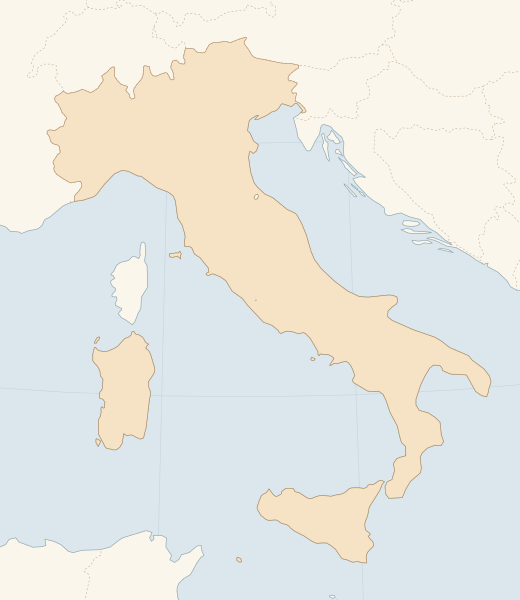
Monte Sant'Angelo on the Gargano: the traditional apparitions of Saint Michael, the heavenly basilica, the bronze doors and the cult of the Lombards.
On the Gargano promontory, in Apulia, more than eight hundred metres high, a white town has grown up around a cave. It is Monte Sant'Angelo, home of the oldest sanctuary in the West dedicated to the archangel Michael. Throughout the Middle Ages the cave drew pilgrims, kings and saints from every corner of Europe, and its model spread as far as Normandy and Ireland. It is still one of the most visited places of worship in southern Italy.
The bull, the arrow and the apparitions
The founding story is told in an early medieval Latin text, the Liber de apparitione sancti Michaelis in Monte Gargano. According to the account, a wealthy local lord named Garganus lost the finest bull in his herd and found it kneeling at the entrance to a cave. Angered, he shot an arrow at the animal, which turned back and wounded him. The Bishop of Siponto, told of the wonder, called for three days of prayer, at the end of which the archangel appeared to him, revealing that the cave was under his protection.
Tradition places this first apparition in 490 and adds others: one during a battle between the people of Siponto and the Neapolitans, won thanks to heavenly intervention, and one in 493, when Michael is said to have announced that he had consecrated the cave himself. Hence the name heavenly basilica, the only church, according to devotion, not consecrated by human hands. Historians regard these dates as traditional, but the cult is certainly very ancient.
The Lombards and the pilgrims
In the seventh century the Gargano came within the orbit of the Lombard duchy of Benevento, and the Lombards, converted to Christianity, made the warrior archangel their protector. They promoted his cult throughout the kingdom, minting coins with his image and dedicating churches to him. On the walls of the approach to the sanctuary survive many inscriptions left by early medieval pilgrims, including some in runic characters, a sign of visitors from the Anglo-Saxon world.
Since 2011 the sanctuary has been part of the UNESCO site «The Longobards in Italy. Places of the power». Monte Sant'Angelo was a stage on the road pilgrims followed towards the ports of Apulia, and from there to the Holy Land. The Gargano stretch is often called the Via Sacra Langobardorum, a name that underlines the bond between that people and the archangel's cave.
The cave, the doors and the statue
One descends to the cave by a long staircase, built under the Angevins, which leads to a portal with bronze doors. The doors were cast in Constantinople and donated in 1076 by Pantaleone, a member of a family of Amalfitan merchants, and bear panels with scenes of angelic apparitions. Inside, the natural cave keeps the altar, the stone episcopal throne and the marble statue of Saint Michael, attributed to the workshop of Sansovino.
Beside the sanctuary stand the octagonal bell tower, built at the behest of Charles I of Anjou, and the so-called baptistery of San Giovanni in Tumba, known in popular tradition as the tomb of Rothari. Every year, on 8 May and 29 September, the town celebrates the archangel with great participation, renewing a devotion that has lasted fifteen centuries.