
Montesiepi and the Sword in the Stone of Saint Galgano
- Coordinates
- 43.15° N, 11.15° E
- Stop
- Rome and Central Italy
- Reading
- 3 min read
- Next
- The Sibyl's Cave and the Legends of the Sibillini Mountains →
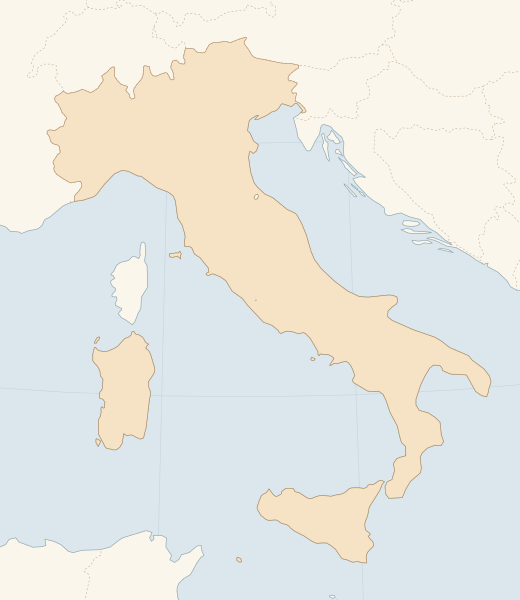
The knight Galgano Guidotti, the sword driven into stone in 1180, the Montesiepi rotunda and the roofless abbey: history and legend in rural Tuscany.
On the hills of the Val di Merse, in the territory of Chiusdino in the province of Siena, a small round church holds an object that seems to come from a chivalric romance: a sword thrust into a rock, of which only the hilt and a short stretch of blade emerge. According to tradition, it was planted there in 1180 by a converted knight, Galgano Guidotti. At the foot of the hill, the grand ruins of a Cistercian abbey complete one of the most evocative landscapes in Tuscany.
A knight who renounces arms
Galgano was born in Chiusdino around the middle of the twelfth century into a family of minor nobility. Hagiographical sources describe him as a young man devoted to worldly life and to arms, until visions of the archangel Michael led him to change his life. Withdrawing to the hill of Montesiepi, he lived there as a hermit until his death in 1181.
The gesture that made him famous is full of symbolism. According to tradition, Galgano drove his sword into the rock, turning the weapon into a cross before which to pray. The knight's renunciation of violence thus became visible and permanent. A few years after his death a process for his canonisation was opened, whose records survive, among the oldest of their kind.
The rotunda and the painted chapel
On the site of the hermitage, in the years after Galgano's death, the rotunda of Montesiepi was built. The dome is formed of alternating concentric rings of pale stone and red brick, a pattern that creates a hypnotic effect and that some have read as an image of the sky or the universe. At the centre, protected by a transparent case, is the rock with the sword.
Beside the rotunda opens a chapel frescoed in the fourteenth century by Ambrogio Lorenzetti and his workshop, with stories of the saint and a Maestà. In a showcase are two mummified hands that legend attributes to a thief, or to one of three men who tried to steal the sword and were attacked by wolves. Analyses carried out in the early 2000s indicated that the metal is compatible with a medieval weapon.
The roofless abbey and the call of Arthur
At the foot of the hill, Cistercian monks built the great abbey of San Galgano in the thirteenth century, in Gothic forms. The monastery went through a long decline, and in the eighteenth century the bell tower collapsed and the vaults gave way. Today the church has no roof: the sky serves as ceiling to the naves, and grass grows where the floor once was.
Many have noticed the resemblance to the sword in the stone of the Arthurian cycle, which appears in French literature between the late twelfth and early thirteenth centuries. Some scholars have suggested contacts between the two traditions, but the relationship remains uncertain. The meaning, in any case, is the opposite: Arthur draws the sword to reign, Galgano plants it to renounce power.
Montesiepi is a place of silence, where history and legend support each other. The sword in the stone, the ringed rotunda and the abbey open to the sky tell of the passage from a chivalry of weapons to a chivalry of the spirit, one of the great ideals of the European Middle Ages.